Mark Kashef thumbnail

📝 Mark Kashef Blog

Building an Agent Army from One Prompt: A Revolutionary Approach to AI Workflow Automation

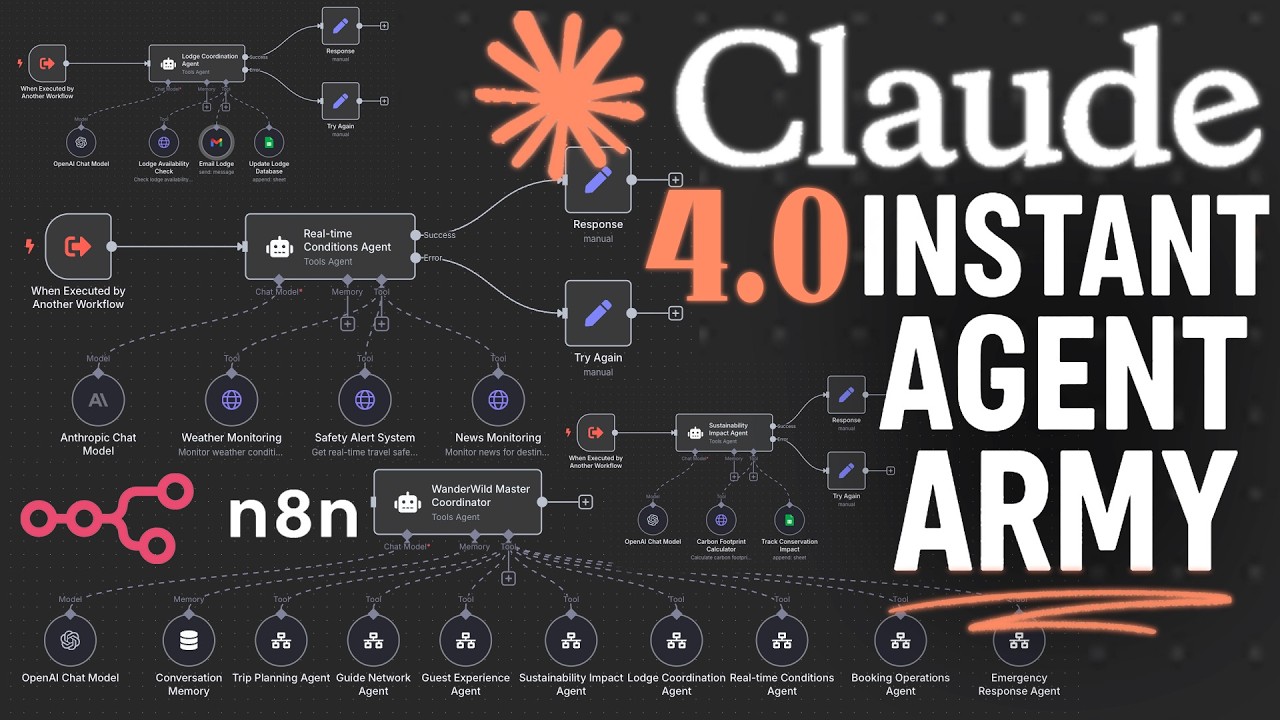
Imagine being able to build an entire army of AI agents tailored to your business needs from just a single prompt — no complex coding required. This is now possible thanks to the innovative capabilities of Claude 4 Opus combined with the power of n8n workflows. In this post, we’ll explore how you can instantly generate sophisticated agent systems with specialized subworkflows, dynamically add tools, and orchestrate everything seamlessly in minutes.

The Power of One Prompt: Two Methods to Generate AI Agent Armies

There are two main approaches to assembling your AI agent army:

  1. Using a Cloud Project: This involves leveraging a structured Claude 4 Opus project enriched with cheat sheets and knowledge bases.
  2. Direct Chat Prompting: Sending a single carefully crafted prompt to generate the workflows directly.

Both approaches require only one prompt, but the Cloud Project method offers more sophistication and reliability by providing additional context and training data for the AI.

Live Demo & Proof of Concept

By sending a prompt along with a set of JSON files defining a master orchestrating agent and its subagents, the system can:

  • Understand how AI agents connect and which tools to attach.
  • Use extended thinking and web search to supplement missing knowledge.
  • Generate multiple workflow drafts within 5-10 minutes.
  • Produce fully importable JSON files that you can copy-paste directly into n8n, ready to run or customize.

Multi-Level Agent Architecture with Dynamic Tooling

The generated agent system features:

  • A master orchestrating agent overseeing multiple specialized subagents.
  • Each subagent equipped with 2-3 (up to 5) carefully selected, real-world tools (e.g., Slack, Zoom, Monday.com).
  • Dynamic model selection, where agents decide whether to use OpenAI’s GPT, Anthropic’s Claude, or others depending on the task.
  • Built-in error and success handling to ensure robust execution.

This layered architecture mimics a well-structured team where each agent has clear instructions and toolsets tailored to their specific goals.

Why Claude 4 Opus Makes This Possible

Claude 4 Opus, combined with extended thinking and web search, forms a trifecta that allows:

  • In-depth reasoning over time.
  • Real-time access to accurate, up-to-date information.
  • Generation of complex JSON workflow files that are 100% valid and importable.

Unlike typical language models, Claude 4 Opus can understand the nuances of AI agent modules and the specific requirements for connecting tools and workflows.

The Core Challenge: Creating Compatible Tools

Not all tools or nodes are compatible with AI agents. For example, trigger-based nodes like “watch new rows in Google Sheets” aren’t suitable because agents require specific action nodes that can be called programmatically.

The prompt explicitly instructs the AI to:

  • Use only verifiable, real APIs and tools (no hallucinated or fictional APIs).
  • Create workflows with clear, valid JSON structures.
  • Attach tools appropriately with success and retry mechanisms.

The Master Prompt Breakdown: How to Instruct the AI

The master prompt acts as an expert workflow architect, guiding Claude 4 Opus to:

  • Analyze a provided business description.
  • Brainstorm 6-8 specialized AI agent roles tailored to the business.
  • Select 2-3 real, verified tools per agent.
  • Generate JSON workflows for 3 initial agents to minimize cost and time.
  • Optionally, extend to more agents after review.

This approach balances creativity, practicality, and resource management.

The Cheat Code: Building a Custom Knowledge Base of Tools

A key insight is the use of an agents_tools.json file, which acts as a cheat sheet or mini knowledge base containing examples of tool integrations with AI agents (e.g., Slack, Asana, Monday.com).

By compiling this JSON with real tool functionalities:

  • Claude 4 Opus better understands how to attach and utilize each tool in workflows.
  • You avoid errors caused by hallucinated or incompatible tool calls.
  • You enable rapid generation of workflows customized to your business stack.

This cheat code is a game-changer for anyone looking to automate complex business processes reliably.

Real-World Business Examples

The approach was tested on three hypothetical businesses, each with distinct toolsets:

  1. Flexiflow Studios (TikTok Agency)
    Tools: Zoom, ClickUp, Slack, Google Sheets, Airtable
    Generated agents: Client Request Handler, Project Setup, Team Coordination

  2. Pet Pal Concierge (Pet Care Service)
    Tools: Airtable, Slack, Zoom, Asana
    Generated agents: Emergency Care Coordinator, Provider Management, Booking & Scheduling, Photo Update

  3. Chaos Coffee Co. (15 Coffee Shops)
    Tools: Google Sheets, Airtable, ClickUp, Monday.com, Slack, Zoom
    Generated agents: Inventory Coordinator, Recipe Innovation, Quality Control, Financial Analytics

Each business received a tailored set of AI agents equipped with the right tools and workflows to optimize their operations — all generated automatically via the prompt and project setup.

Getting Started: From 0 to 80% Done in Minutes

While the workflows generated won’t be perfect out of the box, they provide a solid foundation for customization and refinement. Instead of starting from scratch, you get a highly functional draft that you can tweak to your needs, saving hours or days of manual work.

Resources and Community Access

  • The initial master prompt and sample agent network are available via the video description’s first link.
  • The supercharged version with the agents_tools.json cheat sheet and Claude project files is exclusively available to community members.
  • Joining the community unlocks access to experimental prompts, advanced workflows, and support for building your own AI agent armies.

Final Thoughts

This new method of building AI agent armies from a single prompt represents a major leap forward in automation. By harnessing Claude 4 Opus’s advanced capabilities, combined with a smart prompt design and knowledge base, anyone can rapidly create complex, multi-agent workflows tailored to their business needs without writing code.

Whether you’re a workflow architect, business owner, or AI enthusiast, this approach opens exciting possibilities for scaling automation and intelligence across operations.

Happy building!


Want to try it yourself?
Check out the resources linked below, and consider joining the early AI adopters community for access to exclusive cheat sheets and advanced Claude 4 Opus projects.

Unlock the power of AI agents and transform the way you automate today!